.gif)
.png)
24 February, Mahendranagar
The Ministry of Forests and Environment has published an environmental impact assessment report for road upgrading. The government is going to expand and upgrade the 120 km Kakdavitta-Laukhi road.
The proponents of the road construction report are the Asian Development Bank Project Directorate and the Ministry of Physical Infrastructure and Transport. This road section is the main domestic and international commercial highway of Nepal under the East-West Highway and also has a section of the Asian Highway.
According to the report, the highway improvement project under the South Asia sub-regional financial assistance is planned to upgrade 120 kilometers of roads and bridges from 2 lanes to 4 lanes. The report mentions that the project will help improve the capacity, quality, and safety of the East-West Highway.
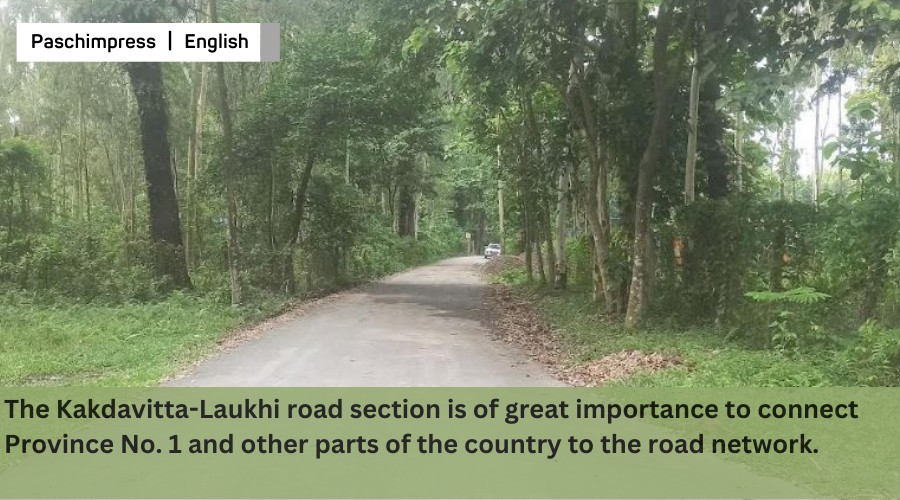
Kakdavitta-Laukhi road section is located in the Jhapa, Morang, and Sunsari districts of Province No. 1. It is mentioned in the environmental impact report that this road section is of great importance to connect Province No. 1 and other parts of the country to the road network.
This road section does not pass through any protected area. The investor of this project is the Asian Development Bank. The 120 km long Kakdavitta-Laukahi road section of the East-West Highway starts from Mechi Bridge and ends at the intersection leading to the Laukahi Koshi Tappu Wildlife Sanctuary.
This road is located in the Jhapa, Morang, and Sunsari districts of Province No. 1. This road passes through 1 sub-metropolitan city, 12 municipalities, and 4 rural villages. The existing roads are mainly two-lane with an average carriageway width of about 7 meters and a 1-meter wide belt on both sides. In urban areas like Birtamod, Damak, and Itahari, it is also seen to be extended to 4 lanes. This road passes through human settlements, agricultural land, forest areas, and streams.
There are 71 bridges on this road. 21 of which are over 50 meters long. Among the bridges currently in operation, there are 6 bridges over 300 meters long which are Ninda Bridge (5+460), Biring Bridge (22+959), Kankai Bridge (29+530), Ratuwa Bridge (47+990), Batra Bridge (57 +550) and Lohendra Pul (78+ 250).
Upgrading existing roads to Asian highway standards has been mentioned in the report. A road design of 50 meters in urban areas, 33 meters in semi-urban areas, and 24 meters in rural and forest areas have been decided.
Road upgradation components include the upgradation of 120 km of roads from 2 lanes to 4 lanes, pavement upgradation, geometry improvements, intersection improvements, bicycle lanes on both sides of roads in urban areas, sidewalks, pedestrian crossings (overhead bridges/underpasses), wildlife crossings, construction of new bridges, drainage improvements, retaining walls; It is mentioned in the environmental report that soil erosion control and stabilization, bus stops and other road safety measures will be constructed.
The major land uses of the project area are human settlement, arable land, forest area, and water bodies/rivers. 84% of the road's jurisdiction is agricultural land (mainly towns, and villages located along highways), 15% is forest and the rest is riverine and others. 50 m Jurisdiction (25 m on both sides from the center) is mentioned in the Road Department report as within the road limits. The average existing formation width of the road is 9 m.
The major rivers are Ninda, Kankai, Biring, Ratuwa, Mawa, Bakra, Chisang, Lohendra, and Gachia. Most of the major rivers in the project area are evergreen. Comsal fluvial sediments of Terai (sand mixed with Gegran) and sedimentary rocks of the Siwalik group such as mudstone, sandstone, pebbly sandstone, and conglomerates are found in the project area.
It is mentioned in the report that 3 thousand 977 trees will be cut due to the event. It is mentioned in the report that the project will coordinate with DFO to plant 139 thousand 770 trees in the ratio of 1:10 to the road for the protection of the forest area and 5 years of maintenance. It is mentioned in the report that 92 million rupees will be spent on environmental monitoring and 30 million 59 million rupees on environmental damage reduction.
The report mentions that the road construction period will be 3 years.
Photo source: Bizness news