.gif)

Mahendranagar, 14 August
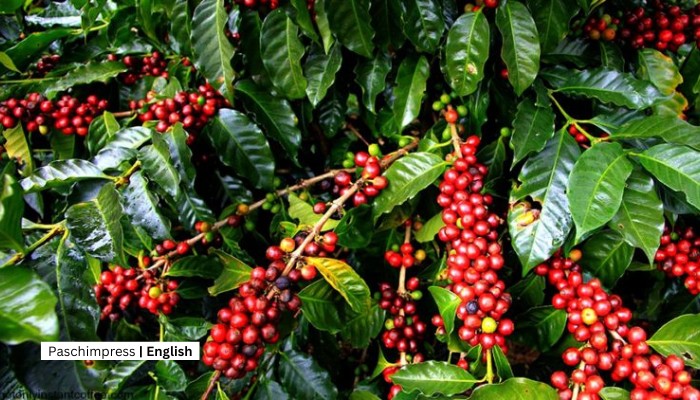
Although there is a lot of potential for coffee cultivation in Sudurpaschim province, it has not started commercial cultivation.
According to the agricultural technician, farming has not been started even though there is a lot of potential due to the view of Far West, lack of clear political system, lack of investors, lack of interest from industrialists, traders and the private sector.
Khagendra Prasad Sharma, head of Agricultural Knowledge Center Kailali, said that although there is a lot of potential for coffee farming in the province, commercial farming has not been possible due to lack of interest from the farmers here. "The demand for coffee produced in Nepal is high in the international market. It is possible to earn a lot of income from this", he said, "According to the demand in the world market, it has not been possible to reach 1% of coffee and 10% of tea."
Chief Sharma said that apart from the districts of Sudurpaschim Province, coffee cultivation is being done on a small amount of land in some other districts. According to him, when Nepali coffee is exported abroad, the price per kg is 16 US dollars.
In 2014, the National Tea and Coffee Board studied the feasibility of coffee cultivation in Doti and Dadeldhura in Far West. According to the study, it is possible to expand coffee cultivation on 64,800 hectares in Doti and 51,330 hectares in Dadeldhura.
According to the study conducted through geographic information (modern technology), there is a potential for coffee cultivation on 190 thousand 246 hectares of land and tea cultivation on 349 thousand 664 hectares of land in the province, informed the executive director of the board, Dr. Bishnu Prasad Bhattarai According to him, there is a high potential for coffee cultivation on 12,200 hectares of land in the province, good on 59,716 hectares and average on 18,330 hectares.
Stating that there are 3,924 hectares of wooded and barren land, 7,855 hectares of grassland and 2,247 hectares of bush land, Director Dr. Bhattarai informed that there is a possibility of tea cultivation. According to him, in terms of geography, climate and soil, there is good potential for 'Arabian' coffee cultivation in the province.
The study has shown that there is a high potential for coffee cultivation in Chure and Dogdakedar Rural Municipality of Baitadi as well as Achham and Bajhang districts of Kailali.
According to an agricultural technician, 70 to 80 percent relative humidity, 1,600 to 2,500 mm of rain, and 15 to 25 °C temperature are required for the cultivation of Arabica coffee, which is in high demand in the market.
A discussion was held between the representatives of the Tea and Coffee Development Board, State Government and local level at the 'Interaction for Integrated Development of Tea and Coffee' program held in Dhangadhi on Sunday. In the event, Ekraj Sanjyal, head of the board's Pyuthan office, said that Nepali coffee fetches more value in the international market in terms of taste and quality.
"It has been found that coffee is consumed the most after petroleum products in the world market", he said, "The demand for Nepali coffee is very high in the international market as there is an understanding that it has the country of Everest, Himalayan quality, balanced taste and unique properties."
According to the statistics released in the program, in the financial year 2077/78, 198.7 metric tons of coffee worth Rs.
In the year 2078/89, coffee worth Rs 127.6 million was imported, while exports worth Rs 117 million were exported in the year 2078/79. Almost 20 percent of the 355 metric tons of green bean coffee produced in Nepal was exported abroad.
According to the board, coffee cultivation was started in Gulmi district in Nepal and currently it is being cultivated in 3,346 hectares in different districts. The board said that it is working to encourage the farmers involved in coffee cultivation and expand the cultivation in the committee area as a 'coffee state' to make them self-sufficient. For this purpose, the Board is planning coordinated work with some district, state and local governments, said the Director of the Board, Dr. Bhattarai.
He said that this year, the board has given priority to the commercial nursery plant production program within the local area by expanding the coffee cultivation area in Chaklabandi for commercial production.
Director Dr. Bhattarai informed that due to the increasing demand for coffee and tea in the market, work is being done in a planned manner in coordination with stakeholders for further expansion of cultivation. "The board is trying to produce organic coffee and promote it further", he said, "The only crop that is set selling price is coffee, the price is set to ensure 20 percent profit by leaving the production cost to the farmers."
Minister of Land Management, Agriculture and Cooperatives of the province Rameshwar Chaudhary said that if coffee farming can be done commercially by involving the youth, the trend of migration abroad will be reduced. "Government is committed to moving forward in collaboration with the board by making a master plan regarding subsidies or concessions that can be given to tea and coffee farming", he said.
As the demand for Nepalese tea and coffee is increasing in the market, the participants of the program stressed that efforts should be made to protect and promote this cultivation for commercial production, and through this cultivation, it can contribute to the fields of job creation, environment protection, sustainable income generation.