.gif)

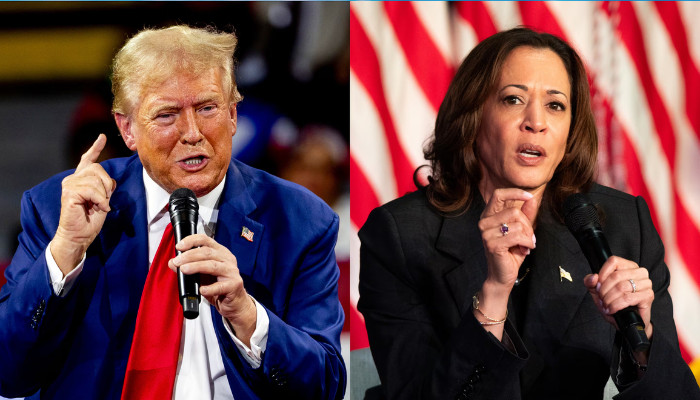
November 5, Tuesday - Voters in America are casting their ballots to elect the 47th President of the United States. With approximately 245 million eligible voters, over 60% voter turnout is expected. Already, more than 75 million Americans have participated in early voting.
While the election is taking place in the United States, the entire world is eagerly awaiting the results. The global anticipation is due to the significant impact the election outcome can have worldwide.
Immigrants and their descendants from various countries, including Asians, Africans, and Hispanics, are among those voting in this American presidential election. Notably, there is substantial participation from Indian and Chinese-origin voters, each group exceeding 5 million, along with over 25,000 Nepalese-origin voters.
Both major candidates are first-generation descendants of immigrants. The Republican candidate, Donald Trump, is the son of a German father and a Scottish mother. His wife, Melania Trump, hails from Slovenia, despite Trump’s political stance of local nationalism. On the other hand, the Democratic candidate, Kamala Harris, is the daughter of an Indian mother and a Jamaican father, representing a mix of Asian and African heritage. However, both candidates have risen as mainstream politicians rather than as representatives of minority communities.
The election generates global discussion, curiosity, and excitement because of the potential worldwide impact of its outcome. Donald Trump, elected president in 2016, and Kamala Harris, elected vice president in 2020, both bring significant weight to their candidacies. They not only represent two different strands of American politics but also aim to promote different global political ideologies and trends.
However, the world is also aware that regardless of who wins, it will not be easy for them to surpass the limits set by the American Constitution and system. Trump is a tested personality, known for his policies during his four-year term, and the world is well-informed about his actions.
Kamala Harris is not a new figure either; her role as vice president in the Biden administration provides ample insight into her thinking and approach, though the vice-presidential position does not carry full responsibility. Hence, Harris would be a new entity as president.
If Harris wins, she will set a record as the first female and second Black president in nearly 250 years of American history, highlighting the incompleteness of American democracy. Barack Obama set the record for the first Black president in the first decade of the current century.
In 2016, Trump faced a female candidate, Hillary Clinton, who received more popular votes but lost due to the Electoral College system. Clinton missed the chance to become the first female president.
Trump’s first presidential term was highly controversial for various reasons, yet his supporters became even more ardent. This ardor culminated in the unfortunate January 6, 2021, Capitol riot, resulting in seven deaths and over a thousand Trump supporters being imprisoned. The world hopes to avoid a repeat of such incidents this time.
In this sense, Trump is a rare figure in American politics. Despite his many controversial actions and policies, he remains popular among the American public. Political scientists often term his peculiar style as populism, though understanding the psychology of Trump supporters remains a global challenge.
This time too, a tight contest between Trump and Harris is anticipated, with the results likely hinging on seven swing states. Significant changes are not expected in the blue and red states.
Compared to Trump, Harris is perceived as a less aggressive, more polite, and civil candidate, expected to carry forward the legacies of former Presidents Bill Clinton, Barack Obama, and the current President Joe Biden. Clinton, Obama, and Biden are actively campaigning for Harris.
A strong basis for Harris’s victory is the unity within the Democratic Party, which is relatively weaker in the Republican Party.
A Trump victory is expected to lead to stricter immigration policies, weakened multilateralism, a further breakdown of the current world order, and a boost for authoritarian regimes worldwide, though Republican supporters dismiss these as mere accusations.
If Trump wins, it might create more ease for Russian President Vladimir Putin. Trump has expressed intentions to halt American support for Ukraine and demands that Ukraine abandon its aspirations to join NATO. Trump’s vice-presidential candidate, JD Vance, strongly emphasized this during the campaign.
If Harris wins, the Biden administration’s stance on the Ukraine war and Middle East tensions is likely to remain unchanged. Concerns about the possibility of a second Cold War and a third World War are prevalent. These concerns are not entirely unfounded, as past wars and Cold Wars did not arise overnight but followed a series of specific backgrounds and long event sequences.
Today, the world is becoming increasingly complex, often referred to as an ‘uncertain world.’ During such uncertain times and transitional policies, achieving the expected progress will be challenging. Global peace and prosperity could be at risk.
Everyone hopes that the US election contributes to a balanced and progress-oriented world order. How American voters are thinking about these issues remains a question.
Possibly by Wednesday evening, the world will know the election results, and global curiosity will find answers.